Long before I understood the great animals of the bush, I learned from something much smaller.
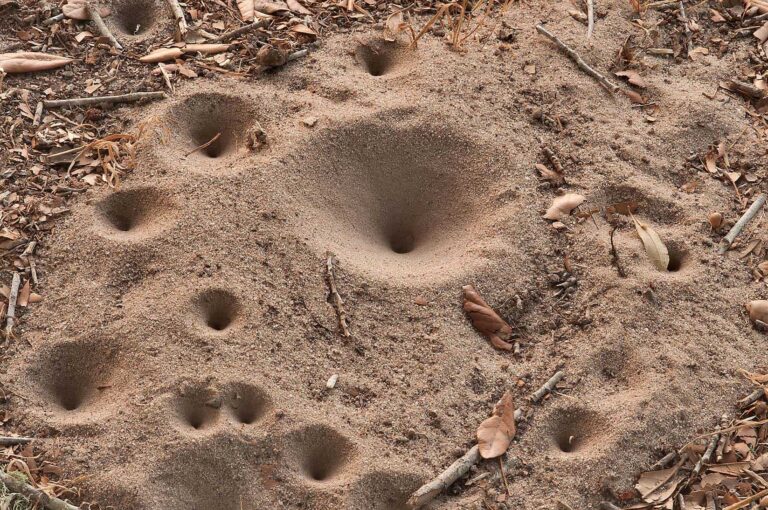
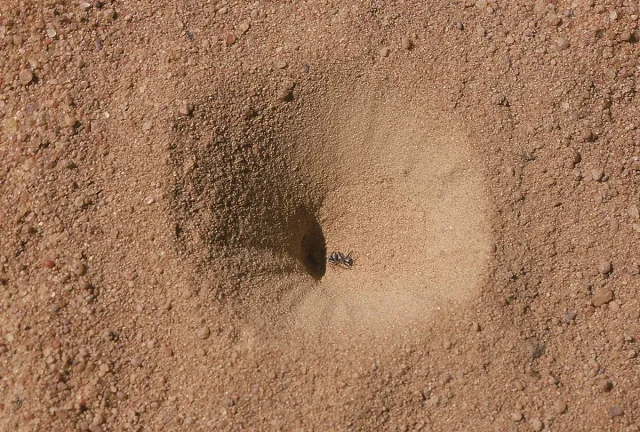
Growing up in Wedza, we spent most of our time outdoors. The ground was our playground, and every patch of soil held some kind of mystery if you looked closely enough. One of the most fascinating things we noticed were the tiny cone-shaped pits in dry sandy ground. They were everywhere along paths, near anthills, and under trees where the soil stayed loose and fine.
We called the creature inside a sand lion.
The sand lion is actually the larval stage of an insect called an antlion, from the family Myrmeleontidae. At this stage it does not fly. It lives beneath the sand as a patient ambush predator. Its body is short and broad with large curved jaws that are far bigger than the rest of it. It looks more like a tiny armored crab than a future flying insect.
What makes it remarkable is not its appearance but its engineering.
The sand lion digs a perfect cone-shaped pit by moving backward in circles, flicking grains of sand outward with its head. The shape is important. The slope is just steep enough that loose sand collapses under the feet of small insects. Ants are its main prey, but any small insect that wanders too close can fall victim.
Once an insect slips into the pit, it struggles to climb out. Each movement causes the sand to slide back down. From the bottom, hidden beneath the sand, the sand lion throws tiny showers of sand upward. This makes the slope collapse further and pulls the prey toward its waiting jaws.
It is patience in its purest form. The sand lion does not chase. It prepares and waits.
As boys, we were curious about everything. To check whether a sand lion was inside, we would sometimes spit into the pit. On less respectable days, we would even pee into it. The sand would harden into mud and the hidden hunter would be revealed, annoyed and exposed. We would pick it up carefully and look at it closely, amazed that such a small creature could be such an effective trap builder.
Sometimes we would also place ants into the traps ourselves, just to watch how it hunted.
Without realizing it, I was already learning how to observe.
The sand lion lives in this larval stage for many months. It sheds its skin several times as it grows. Eventually it stops hunting and forms a cocoon in the sand using silk and grains of soil. Inside, it transforms into an adult antlion. The adult looks delicate, almost like a damselfly, and flies mostly at dusk and night. It does not build pits anymore. Its life changes completely, but its early stage is what defines it.
Years later, standing in the bush near Victoria Falls and explaining animal behaviour to guests, I sometimes remember those pits in Wedza.
Guiding is really the same lesson on a larger scale.
You learn to notice the ground.
You learn to read signs left by movement.
You learn that survival in nature often depends more on patience than strength.
Back then I did not know I would become a safari guide. I only knew I wanted to understand what I was looking at. The sand lion was one of the first teachers I ever had. It taught me to kneel down, to look carefully, and to ask why instead of just passing by.
Even today, whenever I see those tiny cones in the dust, I stop.
Because sometimes the smallest hunter is the one that first teaches you how to see the wilderness at all.