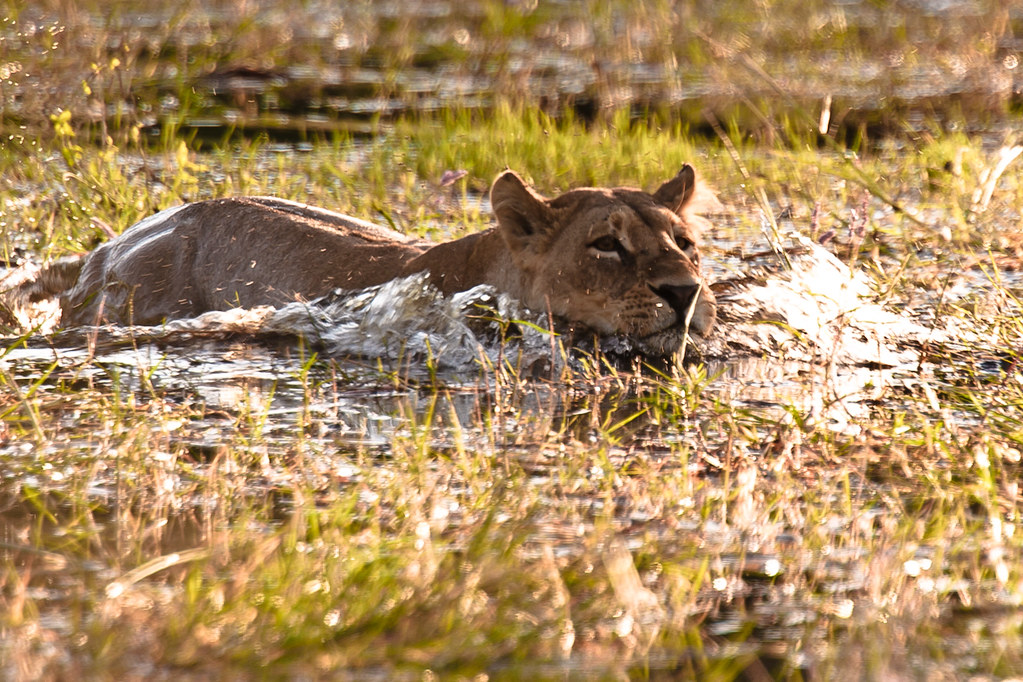
There are lions you expect to see in Africa.
And then there are lions that change what you thought you knew about them.
The Okavango Delta in Botswana is one of those places where expectations do not last very long. It is not a typical savannah. It is a living system of channels, islands, floodplains, and seasonal water that shifts constantly. Land becomes water. Water becomes land. Nothing is fixed.
And yet, in this environment, lions have not only survived.
They have adapted.
When most people think of lions, they imagine dry ground. Open plains. Dust rising under their feet.
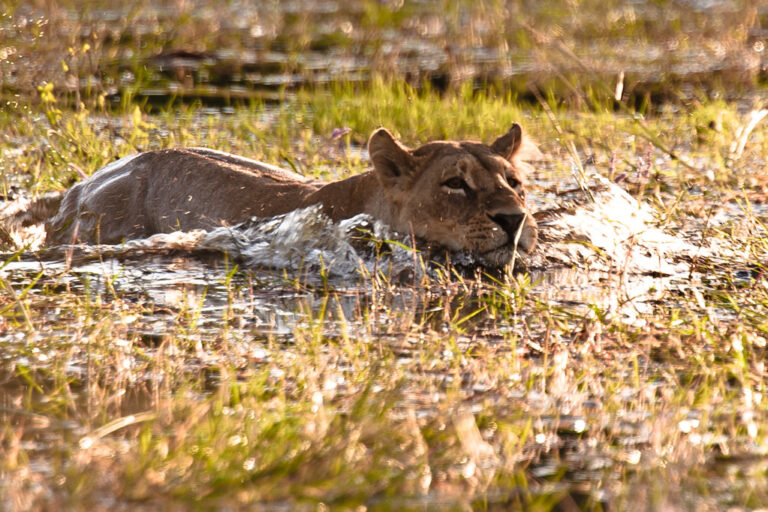
But in the Okavango, lions live in water.
They cross channels that would turn most predators away. They move between islands, often swimming long distances. Over time, many of these lions have developed stronger forequarters, built by the effort of pushing through water and navigating unstable ground.
It changes the way they hunt.
It changes the way they move.
And it changes the way you see them.
The lions of the Okavango are often described as larger and more powerful than those in other regions. Mature males can weigh well over 200 kilograms, and their strength is not just physical, but shaped by the demands of their environment.
This is a place where prey is both abundant and unpredictable.
Unlike more uniform ecosystems, the Delta offers a wide range of species. Red lechwe move through the floodplains. Sitatunga remain hidden in dense wetlands. Buffalo herds gather in large numbers. Even elephant calves can become targets under certain conditions.
Because of this, different prides develop different specialisations.
Some focus on buffalo, working together to bring down animals much larger than themselves. Others adapt to hunting in water, using the terrain to their advantage. And some move more frequently, following seasonal changes as the flood shifts the landscape.
There is no single way to be a lion here.
One of the more unusual features observed in the Okavango is the presence of maned lionesses.
In most parts of Africa, a mane is a clear sign of a male. But here, some females develop visible manes. Studies have shown that these lionesses are genetically female, but have elevated testosterone levels.
The reasons are still being studied.
Some suggest it may influence dominance within the pride. Others believe it may be linked to environmental or genetic factors unique to the region.
Like many things in the Delta, it is not fully explained.
And perhaps that is part of what makes this place what it is.
But for all their strength and adaptability, these lions are not untouched by modern pressures.
Across Africa, lion populations have declined significantly over the past century. In the Okavango, they face challenges that are becoming more common across the continent. Expanding human settlement, conflict with livestock farmers, and illegal hunting all place pressure on their numbers.
Even in a place as vast as the Delta, the balance is delicate.
And it depends not only on the lions, but on how we choose to coexist with them.
As a guide, I have learned that the Okavango does not reveal itself quickly.
You do not rush through it. You move with it.
The same applies to its lions.
You may find them resting in tall grass on an island, surrounded by water on all sides. You may watch them swim silently across a channel at dusk. Or you may follow tracks along the edge of a floodplain and realise they passed through long before you arrived.
They are not always easy to see.
But when you do see them, you understand that you are looking at something more than just a lion.
You are looking at adaptation.
At resilience.
At a species that has learned to live in a world where the ground itself cannot be trusted to stay still.
The lions of the Okavango do not fit the picture most people arrive with.
And that is exactly why they matter.
Because in understanding them, you begin to understand the Delta itself.
A place where nothing stands still, and everything that survives learns how to change.