If you spend enough time in the bush, you learn to watch the ground as much as the horizon.
Large animals capture attention, but the health of the ecosystem is often decided by its smallest workers. Few creatures demonstrate this better than the dung beetle.
Dung beetles belong to the family Scarabaeidae, a large group of beetles found across the world, but Southern Africa hosts an extraordinary diversity. Hundreds of species live here, each adapted to soil type, rainfall patterns, and the animals that share their habitat. Some prefer the sandy soils of Hwange, others the riverine forests near the Zambezi, and some thrive in open grasslands where herds move constantly.
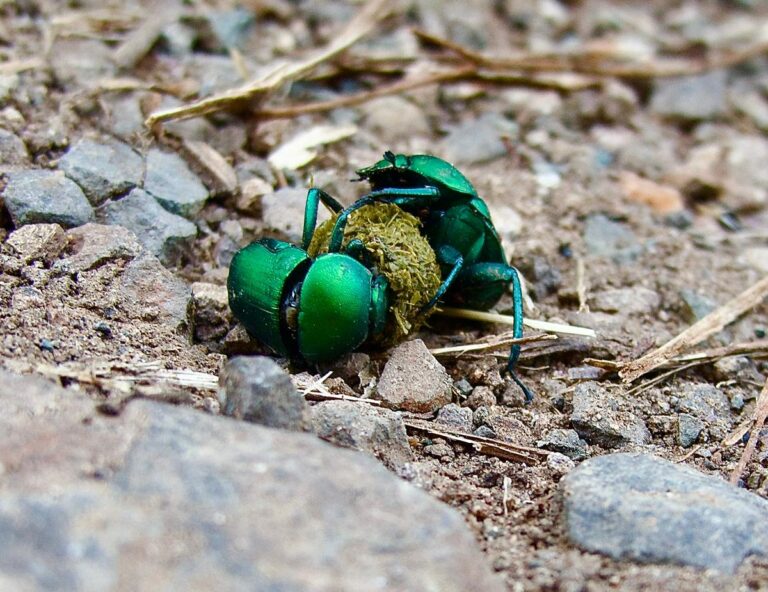
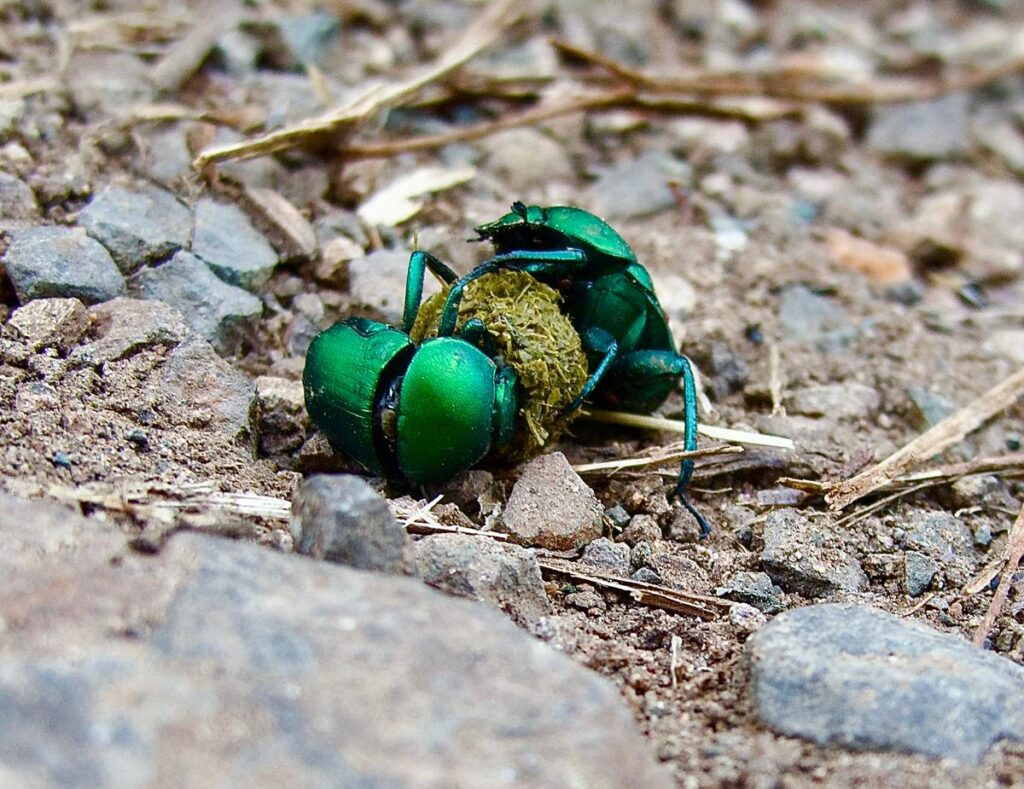
Although people often imagine dung beetles as identical, they vary greatly. Some are dull black and rounded like small stones. Others are armoured with ridges and horns, especially the males that compete for breeding rights. And then there are the smaller metallic species, often bronze or green, which shine in sunlight for a moment before disappearing back into the soil. The beetles in this photograph belong to that smaller group, with a subtle green sheen that catches the eye only when the light hits correctly.
Despite the differences in appearance, dung beetles perform similar roles, and they can be divided into three main behavioural groups.
The rollers form balls from fresh dung and move them away from the original pile. Walking backwards, they guide the ball across the ground with surprising accuracy until they find a suitable place to bury it.
The tunnellers work directly beneath the dung, digging vertical shafts and pulling portions underground.
The dwellers remain inside the dung itself, living and breeding within it without moving it away.
All three are essential. Without them, the bush would slowly suffocate beneath accumulating waste.
Dung is not simply waste in the wild. Herbivore droppings contain undigested plant fibres, bacteria, and nutrients. For dung beetles, it is food for adults and nourishment for larvae. When a female lays eggs inside buried dung, the young hatch into a ready-made food supply, safe beneath the soil where predators and heat are reduced.
The speed at which beetles locate dung is remarkable. Within minutes of an animal passing, they arrive, guided by scent carried across long distances. Competition is intense, and efficiency determines survival. That is why cooperation is sometimes seen, particularly among smaller species handling larger pieces.
In the photograph taken by my colleague Damian Bisset, two beetles are working together to move a portion of dung across the ground. One pushes while the other steadies when the ball slips. It is a small moment, easily overlooked, yet it demonstrates an important principle in ecology. The task is too large for one, but manageable for two.
Beyond feeding themselves, dung beetles perform quiet environmental work. By burying dung they return nutrients to the soil, improve water absorption, reduce parasite loads for grazing animals, and help disperse seeds contained within droppings. Grasslands depend on them far more than most visitors realise.
Over time, guiding teaches you that the success of the wilderness is rarely decided by its most powerful animals. It depends on countless small processes happening continuously beneath notice.
Watching these two small green beetles reminded me that efficiency in nature often comes from shared effort. In the bush, progress is rarely dramatic. It happens through repeated, patient cooperation.
So when you see dung on the road, look closer before stepping over it.
There is a good chance the ecosystem is already hard at work repairing itself.
And the workers are smaller than you expected.