There are places that feel vast.
And then there are places that make you understand what vast really means.
Ntwetwe Pan is one of those places.
It lies within the Makgadikgadi Pans in northeastern Botswana, one of the largest salt pan systems in the world. What you are standing on was once part of an ancient super-lake that covered much of this region thousands of years ago. Today, what remains is a wide, open expanse of pale earth that stretches to the horizon in every direction.
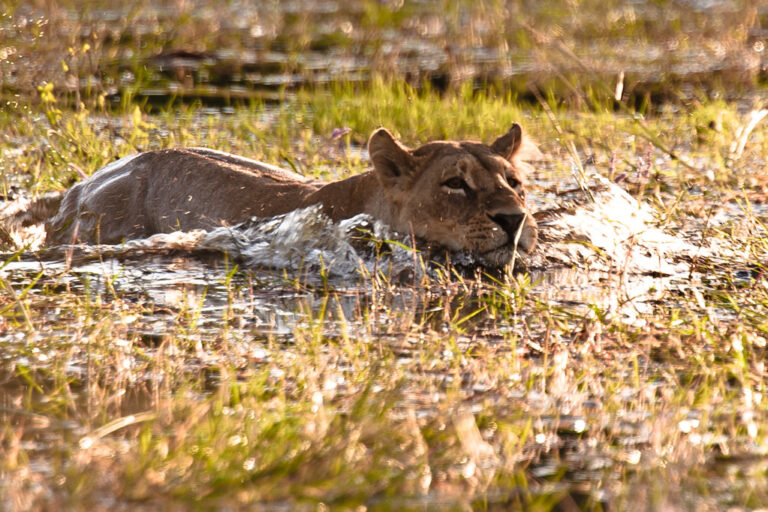
In the dry season, the ground is hard, cracked, and white in places, with fine dust that lifts gently with the wind. In the wet season, parts of it transform, attracting birds and wildlife, briefly reminding you that this was once a living body of water.
There are no mountains to frame your view. No trees to interrupt it. Just space.
And silence.
It is the kind of place that strips things back. You begin to notice smaller details because there is nothing else competing for your attention.
But for me, Ntwetwe Pan has never been only about the landscape.
It is about the people I meet there.
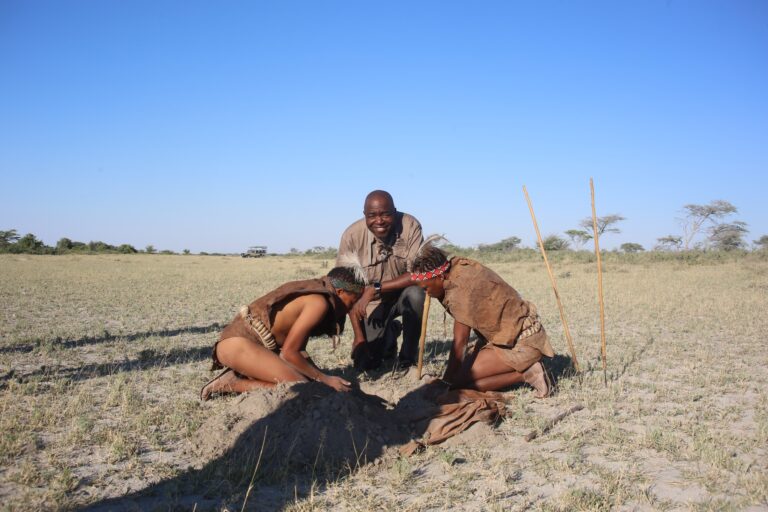
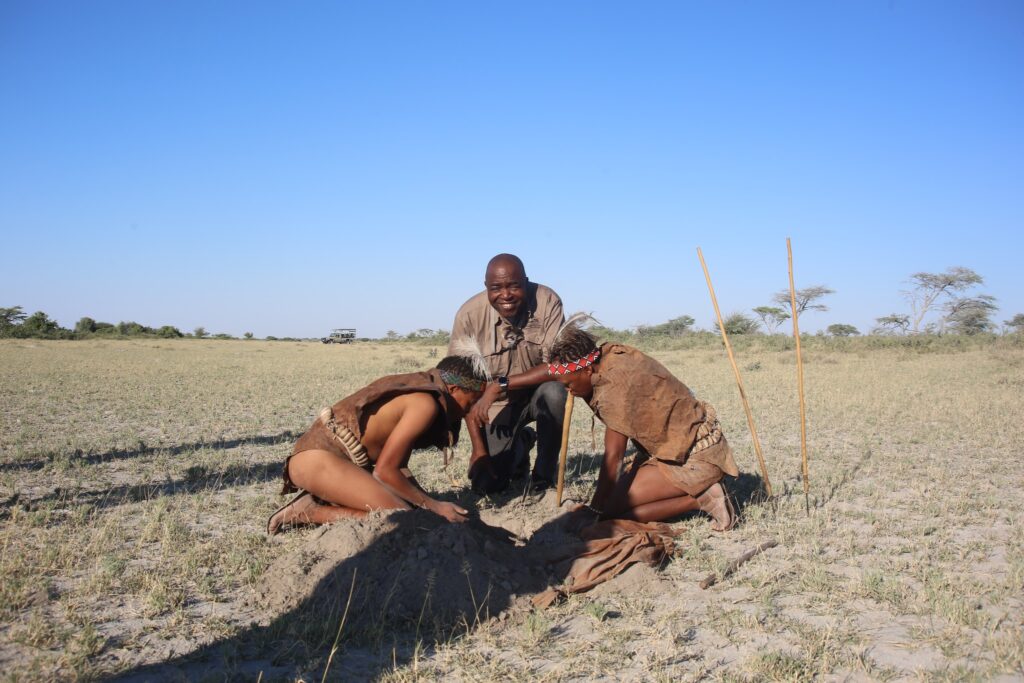
On these journeys, we spend time with the San people, often referred to as Bushmen. I have come to call them my brothers from another mother, because that is how it feels when you walk with them.
The San are among the oldest continuous cultures in the world, with a history in Southern Africa that goes back tens of thousands of years. Long before modern borders, before Botswana, Zimbabwe, or Namibia existed, they were already moving across this land, living as hunter-gatherers, adapting to some of the harshest environments on the continent.
Their knowledge is not written down.
It is lived.
When you walk with them across the pan, what looks empty to most people becomes detailed and alive. A faint track in the sand is not just a mark. It tells you what passed, how long ago, and sometimes even the condition of the animal. A disturbed patch of ground, a broken stem, the direction of a breeze. All of it carries meaning.
Tracking, for them, is not a skill learned in isolation.
It is a way of seeing.
Traditionally, the San hunted using bows and small arrows tipped with poison, often derived from plants or insects such as beetle larvae. The poison works slowly, which means the hunt does not end when the arrow lands. It continues over hours, sometimes days, requiring patience, endurance, and deep understanding of animal behaviour.
They gather as much as they hunt. Roots, tubers, berries, and wild fruits form a large part of their diet. Water, in a place like Ntwetwe, is not always visible. It is found in plants, stored in the ground, or known through memory passed down over generations.
What stands out is not just survival.
It is balance.
They take what they need. They move with the environment rather than against it. There is no sense of excess.
In modern Botswana, the San communities exist in a complex space. Many have been relocated over the years, particularly from areas like the Central Kalahari Game Reserve, as the country developed conservation policies and modern infrastructure. Some communities now live in settlements and engage with tourism as a way to sustain themselves, sharing aspects of their traditional knowledge with visitors.
It is important to understand that what we see on these visits is only a part of a much larger and evolving story.
But even in that context, the depth of knowledge remains.
When I walk with them, I am reminded that guiding, as I practice it, is only one layer of understanding the bush.
There is a moment on every trip when I stop explaining.
And I start listening.
We might be standing in what looks like open, empty ground, and yet they will point out a track I have missed, or notice something I walked straight past. Not because I am inexperienced, but because their relationship with the land is continuous in a way that modern guiding rarely is.
That is where the respect comes from.
Brothers from another mother.
Different journeys, different histories, but the same recognition that the land is something you learn from, not something you master.